
If opening your banking app gives you a flash of anxiety, you aren’t alone. Managing multiple loans, credit card balances, and Buy Now Pay Later (BNPL) plans can feel like juggling flaming torches while riding a unicycle. One missed deadline triggers a domino effect of late fees, skyrocketing high-interest rates, and an unnecessary hit to your credit score.
The good news? You do not need a degree in finance or a six-figure income to break free. What you need is a clear strategy.
1. Take Inventory: Face the Numbers Directly
You cannot conquer what you refuse to look at. The first step toward debt management is getting every single obligation out of your head and onto paper.
Grab a notepad or open a spreadsheet and gather:
-
Lender/Creditor Name: (e.g., Chase, Capital One, Student Loan)
-
Total Outstanding Balance: The total payoff amount.
-
Interest Rate (APR): The annual percentage rate charged.
-
Minimum Monthly Payment: The baseline amount due each month.
-
Due Date: When the payment must post
2. Choose Your Payoff Strategy: Debt Avalanche vs. Debt Snowball
Once your debts are organized, pick a strategic payment method that aligns with your personality. The two most popular methods are the debt avalanche and the debt snowball.
Strategy A: The Debt Avalanche (Best for Math-Minded Saver)
With the avalanche method, you prioritize paying down the debt with the highest interest rate (APR) while making minimum payments on the rest.
-
Why it works: Mathematically, this minimizes total interest paid over time.
-
Best for: People motivated by long-term financial logic over short-term psychological wins.
Strategy B: The Debt Snowball (Best for Quick Wins)
Popularized by financial expert Dave Ramsey, the snowball method focuses on paying off the debt with the smallest total balance first, regardless of the interest rate.
-
Why it works: Eliminating smaller balances quickly provides instant psychological momentum.
-
Best for: Anyone who needs rapid victories to stay committed to a long-term goal.
3. Explore Debt Consolidation Options
If tracking five different due dates feels overwhelming, debt consolidation can streamline your finances. Debt consolidation merges multiple balances into a single monthly payment—often with a lower overall interest rate.
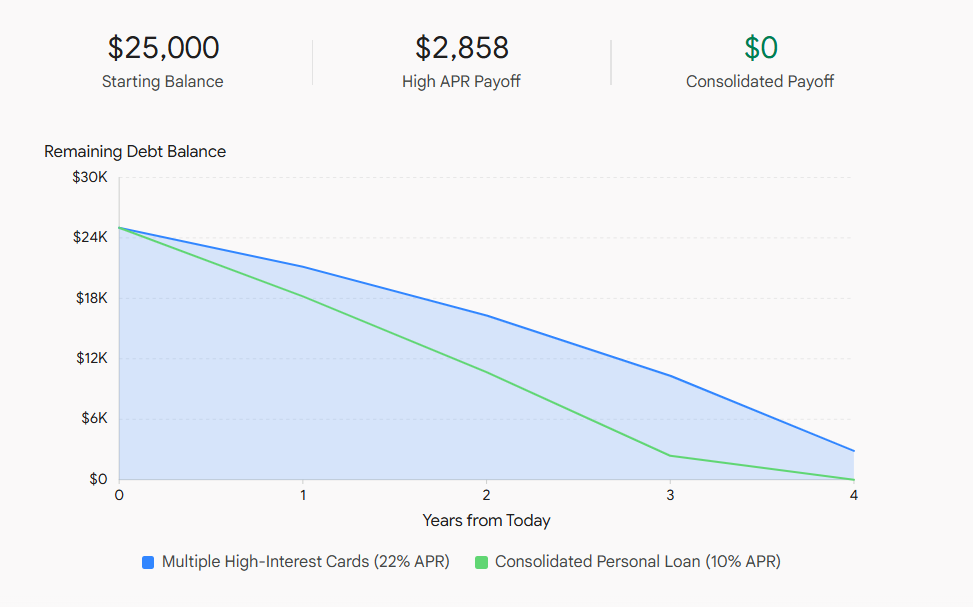
Primary Debt Consolidation Methods:
- Personal Debt Consolidation Loan: Take out a fixed-rate loan from a bank or credit union to pay off high-interest credit card debt. You end up with a fixed payoff date and one predictable monthly payment.
- 0% Intro APR Balance Transfer Card: Move high-interest credit card debt to a card offering a 0% introductory APR for 12 to 21 months. Ensure you pay off the balance before the promo period ends to avoid deferred interest spikes.
Read More: How to Negotiate With Creditors: A Step-by-Step Guide + Script
4. Build a Sustainable Budget to Stop Future Borrowing
To pay off old debt, you must avoid creating new debt. A realistic budget ensures your income covers essentials while leaving room for aggressive repayment.
The 50/30/20 Budgeting Rule:
-
50% Needs: Housing, groceries, utilities, minimum debt payments.
-
30% Wants: Entertainment, dining out, streaming services.
-
20% Financial Goals: Extra debt principal payments, building a modest emergency fund.
Pro-Tip: Do not drain your savings completely to pay off debt. Keeping an emergency safety net of $1,000 to $1,500 protects you from using credit cards when unexpected expenses arise.
5. Contact Lenders and Explore Hardship Programs
If your debt burden feels insurmountable, reach out directly to your lenders. Many creditors offer temporary hardship relief, lower interest rates, or waived fees if you proactively communicate financial strain.
-
Credit Counseling Services: Non-profit credit counseling agencies offer structured Debt Management Plans (DMPs). They negotiate reduced rates directly with your creditors, consolidating your payments without requiring a new loan.
-
Avoid Predatory Debt Relief Scams: Be cautious of companies demanding upfront fees or advising you to stop communicating with your creditors. Stick to reputable agencies accredited by the NFCC (National Foundation for Credit Counseling).
Learn More: How to Get Out of Debt: A Step-by-Step Debt Payoff Plan for Beginners
Final Thoughts: The Journey to Financial Freedom
Becoming debt-free is a marathon, not a sprint. Small, consistent payments compound over time just like interest—only this time, they work in your favor. Pick your strategy, automate your minimum payments, and celebrate every balance that reaches zero.