
Looking at a mountain of debt can make you feel completely paralyzed. Starting with the debt snowball method on a tight budget. Conventional financial advice always seems to assume you have a spare couple of hundred bucks lying around. But when money is already tight, the math feels impossible.
By targeting your smallest balances first, you get fast, motivating “quick wins” that keep you from burning out. Even if you can only find an extra $10 or $20 a month to start, you can build momentum. Let’s walk through exactly how to set up this system, find hidden pockets of cash in a limited cash flow, and systematically reclaim your a debt-free life.
What Exactly is the Debt Snowball Method?
The debt snowball method is a debt payoff strategy where you pay off your debts from the smallest balance to the largest balance, regardless of the interest rate. Think of it like rolling a tiny snowball down a hill. It starts small, but as it rolls, it picks up more snow, gains speed, and eventually becomes a massive, unstoppable force.
How it works
-
You look at all your debts (credit cards, medical bills, car loans, student loans).
-
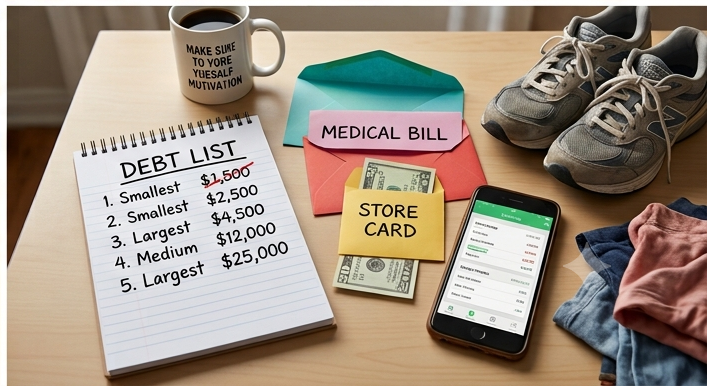
You arrange them in a list starting with the smallest dollar amount at the top and the biggest at the bottom.
-
You pay the absolute minimum payment on every single debt except the smallest one.
-
You throw every extra dollar you can scrape together at that smallest debt until it is completely gone.
-
Once the smallest debt is paid off, you take the money you were paying toward it and add it to the minimum payment of the next smallest debt.
The Psychology: Why It Works When the Math Fails
If you sit down with a mathematician or a traditional accountant, they might tell you that the debt snowball is inefficient. They’ll tell you to pay off the debt with the highest interest rate first to save money on interest. That math-first approach is called the Debt Avalanche.
But human beings are not computers. We don’t make financial decisions based purely on math—if we did, we wouldn’t have debt in the first place! We make decisions based on emotion, habits, and behavior.
When you are on a lean budget, the biggest threat to your stability isn’t a high interest rate; it’s burnout. If you try to pay off a $10,000 credit card with a high interest rate first using just $20 a month, it will take you years just to see the balance budge. It feels like throwing water balloons at a house fire. You get discouraged, you feel like a failure, and you quit.
The Debt Snowball gives you quick wins.
When you pay off a small $150 medical bill in the first month or two, you cross it off your list. That feeling of accomplishment releases dopamine in your brain. You realize, “Hey, I can actually do this.” That psychological boost is the fuel you need to keep going.
But how do you handle debt reduction on a low income? What happens when you are living paycheck to paycheck, and your budget is already stretched to its absolute limit? How do you build a snowball when you feel like you don’t even have a single snowflake to spare? Let’s break down how to achieve financial freedom even when money is tight.
The Core Blueprint: How the Snowball Rolls
Before adjusting the strategy for a when money is scarce, let’s establish the fundamental step-by-step process of the standard debt snowball plan:
Write down every single debt you owe—credit cards, medical bills, student loans, car loans, and personal loans. Organize them strictly by the remaining balance size, from smallest to largest. Ignore the interest rates entirely to keep your focus on behavioral momentum.
Set up automatic payments or calendar reminders to pay the exact minimum monthly payment on every single debt on your list, except for the smallest one. This protects your credit score and prevents late fees while you focus your energy.
Take every extra dollar you can scrape together and throw it at the smallest debt on your list. Continue paying its minimum payment plus this extra amount until the balance hits absolute zero.
Once the smallest debt is completely gone, celebrate! Then, take the entire amount you were paying toward it (its old minimum plus any extra cash) and add it to the minimum payment of the next-smallest debt to begin your true snowball effect.
As each account closes, your monthly paying power increases exponentially. The money “snowballs” into a massive monthly payment that crushes your largest, most intimidating debts faster than you ever thought possible.
Debt Snowball vs. Debt Avalanche: The Real-World Dynamic
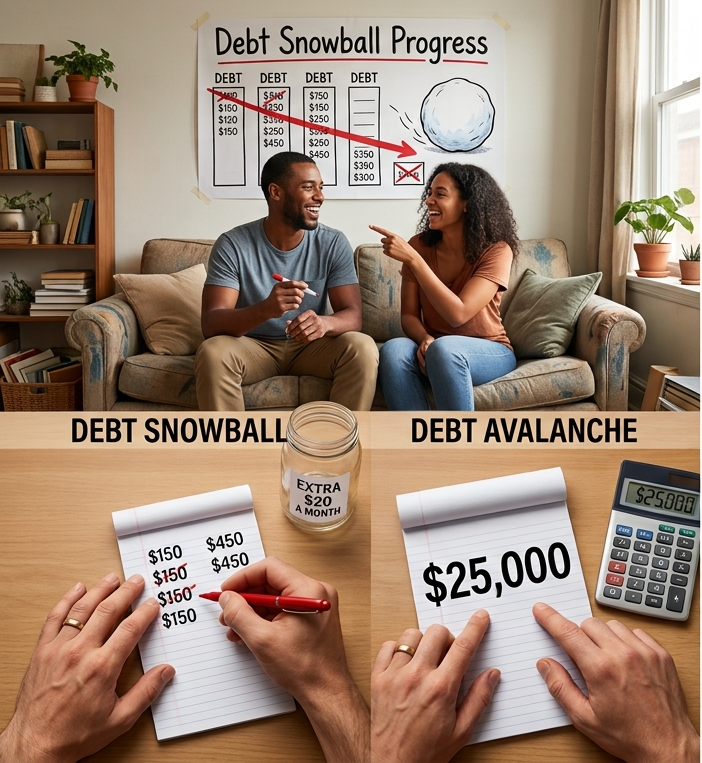
The two primary systems for getting out of debt are the Debt Snowball vs. the debt avalanche. The Debt Avalanche is popularized by financial minds who prefer raw numbers over behavioral psychology. The comparison table below highlights why the Snowball remains the superior choice for budgeting for debt repayment when your cash flow is incredibly tight and your motivation is vulnerable.
| Feature | Debt Snowball Method | Debt Avalanche Method |
| Primary Focus | Smallest balance size | Highest interest rate (APR) |
| Psychological Strategy | Leverages human behavior & quick wins | Relies entirely on strict mathematical logic |
| Cash Flow Impact | Frees up monthly minimum payments quickly | Keeps cash flow locked up for longer periods |
| Risk of Burnout | Low; frequent visual progress keeps you engaged | High; can feel like chipping at a mountain |
| Mathematical Cost | May pay slightly more total interest | Saves the maximum amount of interest |
When you are working on paying off debt on a limited cash flow, freeing up monthly cash flow is a matter of survival. If your highest-interest debt is a $15,000 student loan, and your smallest debt is a $400 medical bill, the Avalanche forces you to grind away at that student loan for years without eliminating a single monthly obligation.
The Snowball wipes out that $400 medical bill in a month or two, permanently eliminating its $30 minimum monthly payment. That is an immediate safety net and an effective method for money management when every dollar counts.
Consider this Real Time Example
| Debt | Balance | Minimum Payment |
| Medical bill | $400 | $30/month |
| Store credit card | $800 | $35/month |
| Credit card | $2,500 | $75/month |
| Car loan | $6,000 | $180/month |
You’ve done the “Scarcity Scrape” and found an extra $20 a month in your budget. Here’s how the snowball rolls:
Months 1–10: You pay the minimums on everything, plus your extra $20 goes toward the medical bill ($30 + $20 = $50/month). The medical bill is completely paid off by month 8.
Month 9: You take the $50 you were putting toward the medical bill and add it to the store card’s minimum payment ($35 + $50 = $85/month). At this rate, the $800 store card — which would have taken almost two years at just the minimum — is gone in about 7 months.
Month 16: The store card is paid off. Now you roll that entire $85/month into the credit card payment ($75 + $85 = $160/month). What started as a $75/month minimum is now a $160/month payoff machine, and the $2,500 balance disappears in about 16 months instead of dragging on for years.
By month 32: You’re down to just the car loan, but now you have $340/month ($180 + $160) to throw at it — nearly double the original minimum payment.
The takeaway: starting with only $20 a month of “extra” cash, by the time you reach your last debt, you’re paying almost 2x the original combined minimums — with zero extra money added from your budget. That’s the snowball effect: the same $20 a month, redirected and compounded through paid-off debts, does the heavy lifting over time.
Strategic Tweaks: How to Start a Debt Snowball on a Tight Budget
To successfully launch a debt snowball when there is no wiggle room in your paycheck, you must apply tactical structural changes to your daily frugal living habits and overall breathing room in your budget.
1. Build the $1,000 “Iron Clad” Starter Buffer
Do not throw a single extra penny at your debt until you have a $1,000 starter emergency fund tucked away in a separate savings account. This step — sometimes called ‘Baby Step 1’ in popular debt-payoff frameworks like Dave Ramsey’s — exists because without it, life’s inevitable curveballs will force you right back into borrowing.
2. Implement a Strict Zero-Based Budget
You cannot afford to let a single dollar wander off untracked. Every single month, before the month begins, sit down and give every single dollar a specific job until your income minus your expenses equals exactly zero.
If you have $3,000 coming in, all $3,000 must be assigned to categories (rent, groceries, minimum debt payments, utilities). If you find an extra $12 left over, it doesn’t stay in your checking account to be spent on a coffee; it gets actively assigned as an extra payment toward your smallest debt balance. Utilizing a zero-based budget ensures you find hidden money to accelerate your progress.
3. The “Scarcity Scrape”: Finding Creative Ways to Save Money
When you think you have no money, you usually have a few hidden leaks. To find them, audit your last three months of bank statements with aggressive honesty. This is where extreme budgeting techniques become your best friend:
-
The Subscription Cull: Cancel every streaming app, gym membership, and digital software subscription. You can survive on free YouTube videos and library books until you are debt-free.
-
The Insurance Shop: Call three competing insurance brokers. Spending two hours switching your auto or renters insurance can instantly free up $30 to $50 a month in structural savings.
-
The Utility Audit: Turn the thermostat down a couple of degrees in the winter or up in the summer. Call your internet service provider and threaten to cancel to drop down to their lowest promotional tier.
What If a Debt Is Already in Collections?
Not all debt fits neatly into a “minimum payment” structure. If a bill has already been sent to collections — meaning the original creditor gave up on collecting and sold or assigned it to a collection agency — the rules change a bit.
A few things to know:
- Settlements are often possible. Collection agencies frequently buy debt for pennies on the dollar, which means they may accept a lump-sum payment for less than the full balance owed just to close the account. It’s worth asking whether a reduced, one-time settlement is available before committing to a long payment plan.
- Get any agreement in writing before paying. Verbal promises from a collections agent aren’t reliable. Always ask for the settlement terms in writing (a “pay for delete” letter or settlement agreement) before sending any money.
- Where it fits in the snowball. A collections account with a small remaining balance can actually make a great “first target” in your snowball line-up, especially if you can negotiate it down further through a settlement — it may become your smallest, fastest win.
- Know your rights. Debt collectors are limited by law (the Fair Debt Collection Practices Act in the U.S.) in how they can contact you and what they can say. If you feel harassed or pressured, you’re allowed to request communication in writing only.
- Consider nonprofit help. If you’re dealing with multiple collections accounts and aren’t sure how to prioritize or negotiate, a nonprofit credit counseling agency (like those accredited by the NFCC) can review your accounts and help you figure out next steps for free or low cost.
When the Snowball Might Not Be Your Best Option
The debt snowball is a great fit for many people, but it isn’t the only tool available, and it may not always be the fastest or cheapest path depending on your specific mix of debts. A few alternatives worth knowing about:
- Balance Transfer Cards: If most of your debt is on high-interest credit cards and you have decent credit, a balance transfer card offering 0% interest for 12–18 months can let you pay down the principal without interest piling up. This can outperform the snowball method if your balances are large relative to your minimum payments.
- Debt Consolidation Loans: Rolling multiple debts into a single personal loan with a lower fixed interest rate can simplify your payments into one bill and potentially lower your overall interest cost — though this works best if your credit score qualifies you for a decent rate.
- Nonprofit Credit Counseling / Debt Management Plans: Agencies accredited by the National Foundation for Credit Counseling (NFCC) can sometimes negotiate lower interest rates with your creditors and combine payments into a single monthly amount, often at little to no cost to you.
- Debt Avalanche: As covered earlier, if you’re someone who’s motivated by saving the most money mathematically rather than needing quick emotional wins, the avalanche method (highest interest rate first) may keep you more consistent and save you more in the long run.
- Debt Settlement: For larger debts already in serious delinquency, negotiating a lump-sum settlement for less than the full balance is sometimes possible, though it can affect your credit score more significantly than steady repayment.
The right choice depends on the size of your debts, your credit score, and what keeps you motivated. If your balances are small and scattered, the snowball’s quick wins are hard to beat. But if you’re carrying a few large, high-interest debts, it may be worth comparing whether a consolidation loan or balance transfer could get you out of debt faster and cheaper — the snowball method doesn’t have to be an all-or-nothing choice.

Overcoming Common Traps on the Road to get out from under debt
Tackling credit card debt and other loans on a low income is a long-distance mental game. Expect these roadblocks and prepare your defense strategy in advance:
-
The Treading-Water Phase: If your total extra cash flow is only $15 a month, your snowball will start incredibly slowly. Do not panic. The habit of consistency is far more valuable than the initial dollar amount. Wiping out a tiny $80 store card balance in five months still proves to your subconscious that the system works.
-
The Emergency Pause: If you experience a sudden crisis like a job loss or a medical emergency, immediately pause the extra payments on your snowball. Continue making only the absolute minimum payments to keep your accounts open, and hoard every extra dollar in cash until the crisis passes and stability returns.
-
The Lifestyle Creep Temptation: As you successfully eliminate your first two or three small debts, your available monthly cash flow will visibly grow. The temptation to absorb that newly freed cash into your lifestyle (eating out more, buying better clothes) will be intense. You must stay focused. Remind yourself that the freed cash is not income; it is ammunition reserved exclusively for the next target on your list.
Regain control of your money isn’t reserved exclusively for high earners. By focusing entirely on changing your daily habits, securing quick wins, and rolling every freed dollar forward, you can permanently escape the debt cycle—no matter how tight your budget is today.