
Managing several loans at once is a common reality for millions of Americans. Between credit cards, auto loans, personal loans, and student debt, it is easy to feel like your paycheck vanishes the moment it hits your account. Multiple due dates and interest rates make it difficult to keep track of your financial progress.
You do not need a degree in finance to regain control of your money. What you need is a clear system. Managing multiple loans comes down to organizing your debts, choosing a focused payoff strategy, and running your plan consistently.
Step 1: Build Your Complete Debt Inventory
You cannot defeat what you cannot see. The first step to managing multiple loans is getting every single debt out of your head and onto paper.
Gather your latest monthly statements or log into your online accounts. List every debt you owe along with five key details:
-
Lender Name: The bank or financial institution you owe.
-
Total Balance: The exact dollar amount required to pay off the account today.
-
Interest Rate (APR): The Annual Percentage Rate charged on the debt.
-
Minimum Monthly Payment: The baseline amount required each month to keep the account current.
-
Due Date: The calendar day payment is required.
Knowing your numbers eliminates uncertainty. It shows you exactly where your money goes every month and gives you a baseline to build your strategy.
Step 2: Choose Your Payoff Strategy (Avalanche vs. Snowball)
Paying only the minimum balances across multiple loans will keep you stuck in debt for years. To make real progress, pay the minimum on every account except one. Throw any extra money you can afford toward that single target debt.
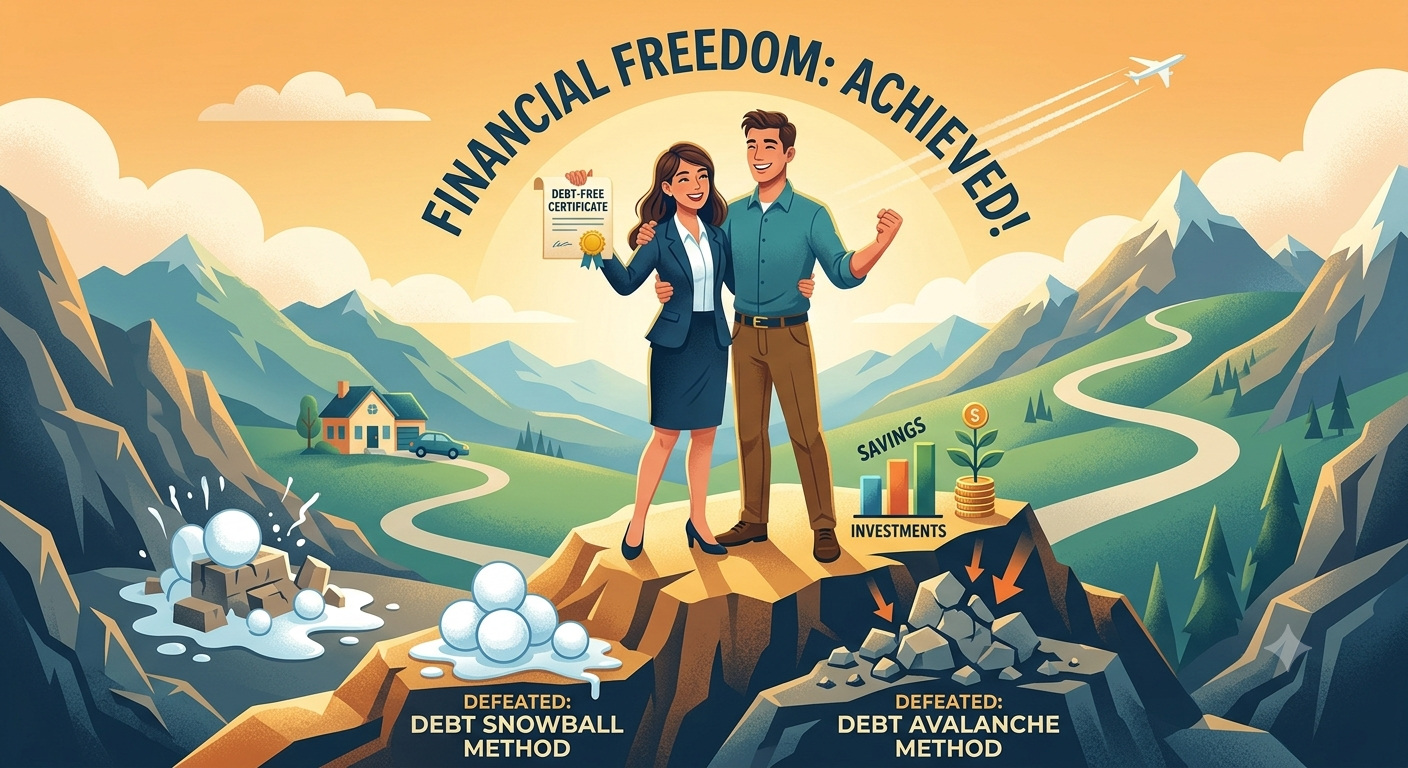
There are two primary methods for picking your target debt: the Debt Avalanche and the Debt Snowball.
The Debt Avalanche Method
With the Debt Avalanche, you focus all your extra cash on the loan with the highest interest rate (APR). You continue paying minimums on all other debts. Once your highest-rate loan is paid off, you take its entire payment amount and direct it toward the loan with the next highest APR.
-
Best for: Saving the maximum amount of money on interest charges.
-
How it works: Mathematically, this is the fastest way to become debt-free.
The Debt Snowball Method
With the Debt Snowball, you focus your extra cash on the loan with the smallest total balance, regardless of interest rate. Once that smallest balance drops to zero, you roll that payment over to the next smallest balance.
-
Best for: Building momentum and psychological wins.
-
How it works: Seeing accounts close completely gives you quick motivation to keep going.
Real-World Example: Seeing the Math in Action
To see how these strategies compare, let us look at a realistic financial scenario.
Imagine you carry three separate debts totaling $28,000:
-
Credit Card: $10,000 balance at 24% APR (Minimum payment: $250/month)
-
Personal Loan: $3,000 balance at 15% APR (Minimum payment: $100/month)
-
Auto Loan: $15,000 balance at 7% APR (Minimum payment: $350/month)
Your required minimum monthly payments total $700. Suppose you review your monthly budget and decide you can afford to pay $1,000 total each month toward your debt. That gives you $300 in extra monthly cash flow to attack your target loan.
Here is how the numbers play out under both strategies:
-
Under the Debt Avalanche: You send the extra $300 to the 24% APR Credit Card (paying $550 total per month to it) while paying the minimums on the personal loan ($100) and auto loan ($350). You will pay off all three loans in 39 months (3 years and 3 months) and spend $5,285.28 in total interest.
-
Under the Debt Snowball: You send the extra $300 to the $3,000 Personal Loan first (paying $400 total per month to it) because it is your smallest balance. You pay off all three loans in 40 months (3 years and 4 months) and spend $6,151.94 in total interest.
The Math Verdict: The Debt Avalanche saves you $866.66 in total interest and finishes one month earlier because it targets the high-interest credit card debt immediately.
Step 3: Simplify with Loan Consolidation or Balance Transfers
If tracking multiple monthly payments feels overwhelming, you can streamline your debt structure using consolidation tools.
Personal Debt Consolidation Loans
Debt consolidation involves taking out a single new loan to pay off multiple existing debts. Instead of managing three or four separate bills, you make one single fixed monthly payment to one lender.
Using our previous scenario of $28,000 in total debt, let us see how consolidation changes the numbers.
If you qualify for a 3-year (36-month) debt consolidation loan at a 10% APR:
-
Your single monthly payment becomes $903.48.
-
Your total interest paid over 36 months drops to $4,525.32.
Compared to the Debt Avalanche, consolidating at a 10% APR saves you $759.96 in interest and finishes 3 months faster. Compared to the Debt Snowball, it saves you $1,626.62 in interest.
Consolidation works best if you have a fair to good credit score (typically 670 or higher) and can secure an interest rate significantly lower than the average rate across your current loans.
Related links: The Ultimate Guide to the Best Debt Consolidation Loans of 2026: Compare Rates, Bad Credit Options & No-Fee Lenders
0% APR Balance Transfer Credit Cards
If a large portion of your debt comes from high-interest credit cards, a 0% APR balance transfer card offers a temporary window to eliminate principal without interest accumulating.
Many US card issuers offer promotional periods ranging from 12 to 21 months with 0% APR. However, keep two critical factors in mind:
-
Balance Transfer Fees: Most cards charge a fee of 3% to 5% of the transferred balance. Transferring $10,000 will cost between $300 and $500 upfront.
-
Promotional Window: You must pay off the balance before the promotional period ends. Any remaining balance after the offer expires will incur standard interest rates, often exceeding 20% to 25% APR.
Step 4: Automate Payments and Protect Your Credit Score
Missing a payment on any of your loans can trigger late fees and cause your credit score to drop. A single late payment reported 30 days past due can reduce a strong FICO score by up to 100 points.
To protect your credit score:
-
Set Up Autopay: Automate the minimum required payment for every single loan account. This guarantees you will never miss a due date.
-
Manual Extra Payments: Make your additional principal payments (the extra $300 from our example) manually or schedule them right after payday.
-
Keep Old Accounts Open: If you pay off a credit card, leave the account open unless it charges an expensive annual fee. Closing an account reduces your total available credit, which can raise your credit utilization ratio and temporarily lower your score.
Protect Yourself with a Small Cash Buffer
Before throwing every available dollar at your loans, build a small starter emergency fund of $1,000 to $2,000 in a high-yield savings account.
Without a cash buffer, an unexpected bill—like a car repair or medical copay—will force you to rely on high-interest credit cards again, creating a cycle of recurring debt.
Your 3-Step Action Plan
-
Catalog your accounts and calculate your extra cash flow by Friday: Write down all balances, interest rates, minimum payments, and due dates. Identify the total extra amount (e.g., $300/month) you can direct toward debt repayment.
-
Select your payoff strategy by the end of this week: Decide whether the Debt Avalanche, Debt Snowball, or a 10% APR consolidation loan fits your financial profile. If consolidating, pre-qualify with local credit unions or online lenders to compare APRs without affecting your credit score.
-
Automate minimum payments and establish a $1,500 emergency buffer within 30 days: Set up automatic monthly payments for all minimum balances. Direct all remaining free cash flow toward your starter emergency fund until you reach $1,500, then pivot that full amount toward your chosen target debt.
Frequently Asked Questions
Is it better to pay off multiple loans one by one or all at once?
It is always better to pay minimum balances on all accounts while focusing extra money on one single loan at a time. Spreading extra payments evenly across multiple loans slows down your visible progress and increases total interest costs over time.
Will consolidating multiple loans hurt my credit score?
Applying for a new consolidation loan causes a minor, temporary dip of 3 to 5 points on your credit score due to the hard credit inquiry. However, paying off multiple credit card balances with a single personal loan lowers your credit utilization ratio, which usually boosts your credit score within a few months.
Should I use my 401(k) or emergency fund to pay off multiple loans?
It is generally unwise to borrow against or withdraw from your 401(k) to pay off loans. 401(k) withdrawals trigger tax penalties and eliminate compounding returns on your retirement investments. Keep a small emergency fund of $1,000 to $2,000, but use any savings above that amount to pay off high-interest consumer debt.
What should I do if I cannot afford minimum payments on my loans?
Contact your lenders immediately before you miss a payment. Many lenders offer hardship programs that temporarily reduce interest rates or pause monthly payments. You can also consult a non-profit credit counseling agency (such as the National Foundation for Credit Counseling in the US) to explore a structured debt management plan.
Taking control of multiple loans requires a clear process and consistency. By listing your balances, choosing between the avalanche or consolidation methods, and automating your payments, you can systematically reduce your debt, lower your stress, and keep more of your hard-earned money each month.
Do you have specific loan balances and interest rates you would like to run through the Debt Avalanche or consolidation model to see your customized timeline?