
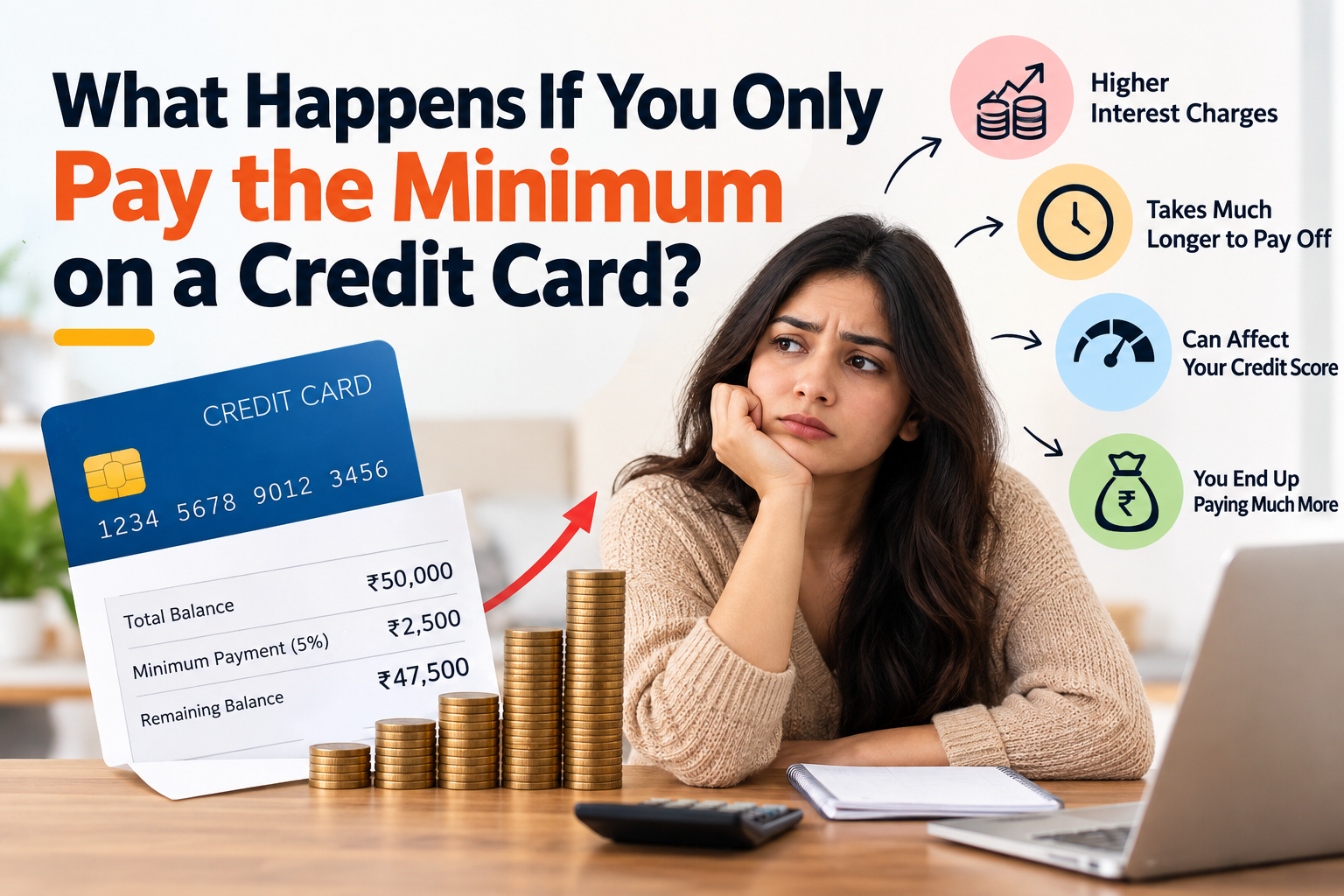
Making only the minimum credit card payment keeps your account in good standing and prevents late charges, but it locks you into a high-interest cycle. Unpaid balances incur high Annual Percentage Rates (APR)—often ranging from 18% to 36% or higher. This revokes your interest-free grace period, elevates your credit utilization ratio, hurts your credit score, and can turn even minor purchases into long-term debt lasting years or decades.
What Happens If You Only Pay the Minimum on a Credit Card?
Imagine charging a $1,000 laptop to your credit card. When your billing statement arrives, the issuer asks for a modest payment—perhaps just $25. It can be tempting to pay the $25 and keep the remaining cash in your bank account.
While that $25 payment prevents your bill from being marked late, it sets off a quiet financial compounding effect. Below is a breakdown of how credit card minimums work, why the math favors the lender, and how to protect your financial health.
1. What Is a Credit Card Minimum Payment?
The minimum payment amount is the smallest dollar figure you must submit to your lender by the due date to satisfy your contract for the billing cycle.
Meeting this obligation ensures:
-
No late fees: You avoid penalty fees for missed deadlines.
-
Positive payment history: Your report avoids 30-day delinquency marks.
How Lenders Calculate Your Minimum
Card issuers typically determine minimum dues using one of three formulas:
-
Percentage of total balance: Commonly 1% to 3% of your end-of-cycle balance.
-
Interest plus principal contribution: Total interest accrued during the month plus 1% of the principal balance.
-
Fixed floor amount: A baseline of $25 to $35 (or local currency equivalent) if the percentage calculation yields a lower number.
Because this payment covers mostly interest charges and very little principal, your balance reduces very slowly.
2. Key Impacts of Paying Minimums Long-Term
Paying only the minimum maintains your account status, but carrying revolving debt causes several secondary effects:
- Daily Compounding Interest Accrual
Credit cards carry some of the highest revolving interest rates in consumer finance, with average APRs hovering between 20% and 25% globally (and higher in specific credit brackets). Carrying a balance means interest is computed on your average daily balance, causing interest to accrue on prior interest.
- Loss of the Interest-Free Grace Period
Cardholders who pay their full statement balance each month enjoy an interest-free grace period (usually 21 to 25 days) on new purchases. When you roll a balance over into a new billing cycle, that grace period is voided, and new transactions incur interest from the day they post.
- Extended Repayment Duration
Because minimum payment requirements drop as the balance decreases, the dollar amount paid drops alongside it. This structure prolongs the repayment schedule. Clearing a $5,000 balance under standard minimum terms can take decades.
- Elevated Credit Utilization Ratio
Your credit utilization ratio—the proportion of available credit you are currently using—makes up about 30% of standard credit scoring models. Carrying balances near your credit line signals higher risk to lenders, which can lower your credit score even with consistent, on-time minimum payments.
Learn More: How to Negotiate With Creditors: A Step-by-Step Guide + Script
How to Get Out of Debt: A Step-by-Step Debt Payoff Plan for Beginners
3. Comparing Payoff Trajectories
Below is an illustration of a $5,000 debt at 21% APR, assuming a typical minimum payment formula (2% or $25 minimum):
| Strategy | Initial Monthly Payment | Estimated Payoff Time | Estimated Interest | Total Cost | Minimum Only | ~$100 (declines over time) | 22+ Years | ~$6,900+ | ~$11,900+ | Fixed $200/Month | $200 (constant) | 2 Years, 8 Months | ~$1,510 | ~$6,510 | Fixed $350/Month | $350 (constant) | 1 Year, 5 Months | ~$795 | ~$5,795 |
Maintaining a constant payment rather than letting the minimum shrink saves thousands in interest charges and significantly reduces the repayment period.